Jiayi Lu (Chloe)
Good ethics, good products, good hearts and good vibe only.
About Me

Chloe is a distinguished professional in the fields of product management and UX design, currently residing in Vancouver, British Columbia. Her expertise lies in crafting unique digital experiences and strategies that cater to a diverse range of businesses and users.
Chloe's journey into the digital design world is marked by a deep-seated passion for solving complex user experience puzzles. With a solid background in project management, she has honed her skills in resource allocation, roadmap management, and innovative problem-solving, consistently translating these into successful project outcomes. Her proficiency spans working with both budding start-ups and established enterprises, reflecting her adaptable nature.
The educational foundation that Chloe has built underpins her abilities as a creative problem solver. As a certified User Experience Designer, she continuously seeks opportunities for growth and embraces new challenges in the ever-evolving digital landscape. Her commitment to inclusive design showcases her dedication to crafting experiences that resonate with end-users from all walks of life.
Professionally, Jiayi Lu (Chloe) is consistently eager to take on projects that allow her to contribute her skills to the burgeoning world of digital innovation. She is open to engaging in both freelance opportunities and long-term collaborations, ensuring a tailored approach to each unique challenge. Her fluency in Mandarin, Cantonese, and English enables her to operate seamlessly across different cultural contexts, adding a valuable dimension to her professional outreach.
Jiayi Lu’s dedication to her craft, matched with her creative prowess, positions her as a reliable partner for those seeking to enhance their digital presence. Whether it's through dynamic UX design or strategic product management, Chloe is committed to making a meaningful impact in the digital realm.
social
Message me
Articles
I Tested OpenAI's New Voice Model. Here's Where It Shines and Where It Still Falls Short.
I spent some time testing GPT Live, OpenAI's new voice model, and I came away with two distinct feelings: genuinely impressed, and still waiting for something more. Both feelings matter, and I think they point to a gap that the whole industry is circling around right now.
This is not a review in the traditional sense. It is more of a working observation from someone who thinks about voice AI as a product problem every day. And the honest answer is: the bar has moved, but it has not moved all the way.
## What GPT Live Gets Right
The voice mechanics are noticeably better. GPT Live handles interruptions in a way that actually feels natural. You can cut in mid-sentence, redirect, trail off, and it adjusts without the clunky pause that used to signal an AI resetting itself.
What surprised me most was the non-verbal behavior. It responds with "mm-hmm," "aha," small sounds that signal it is listening and processing. It even laughs at the right moments, naturally, not performatively. These might sound like minor details, but they are not. They are the texture of real conversation, the things that make you feel heard rather than processed.
For lightweight, daily use, GPT Live is genuinely good. Commands, quick exchanges, ambient assistance, that kind of interaction. It mimics the rhythm of human conversation well enough that you stop thinking about the mechanics and just talk. That is a meaningful achievement, and it is worth acknowledging clearly.
## Where the Depth Starts to Break Down
Here is where I need to be honest about what I actually experienced, not what the demos suggest.
When I pushed into a deeper, more exploratory conversation, something shifted. I was rambling, working through a thought out loud the way you do when you are genuinely trying to figure something out. And instead of catching the underlying point I was building toward, GPT Live followed my last sentence. It picked up on the most recent words I said and responded to those, which sent the conversation in a slightly different direction than I intended.
That drift was subtle at first. But over the course of a longer exchange, I noticed the topic moving away from where I started. It was not wrong exactly. It was just not with me. It was responding to the surface of what I said rather than the core of what I meant.
This is the distinction that matters most to me as a product thinker. There is a real difference between a model that responds accurately and a model that engages meaningfully. GPT Live does the former well. The latter is still a work in progress.
Deep conversation requires holding context across a rambling, non-linear exchange. It requires understanding that the last thing someone said is not always the most important thing they said. That takes more than pattern matching on recent input. It takes something closer to genuine comprehension, and that is still hard.
## Why This Gap Is Actually a Significant Product Problem
The non-verbal signals GPT Live produces create a powerful illusion of presence. You feel heard. You feel like something is listening and thinking alongside you. That experience is valuable, and it builds trust quickly.
But when that same model then drifts from your underlying thought, the dissonance is jarring in a way that is hard to articulate. It is the equivalent of someone nodding along to everything you say and then responding to the wrong thing. The warmth of the interaction makes the miss feel more confusing, not less.
For lightweight use cases, this does not matter much. But voice AI is increasingly being positioned for higher-stakes interactions: coaching, discovery conversations, complex decision support. In those contexts, drifting from the user's underlying intent is not a minor inconvenience. It is a trust problem.
This is something I think about a lot in the context of what we are building at Bono. Through my own real usage, I have found that Bono actually catches my rambling and structures my underlying thoughts rather than just responding to the last thing I said. That has been genuinely useful in a way that is hard to fake. It is the kind of capability that only becomes visible when you do the slow work of testing voice AI in real, messy, exploratory conversations rather than clean demo scripts.
## What This Means for the Industry
GPT Live is a signal, not a ceiling. It shows how far voice mechanics have come, and it raises the expectation for what conversational AI should feel like at a surface level. That is good for everyone building in this space, because it moves the baseline forward.
But it also clarifies where the real work still needs to happen. Mimicking the texture of human conversation is achievable. Actually following the thread of a human thought, the messy, nonlinear, half-formed kind, is a different and harder problem.
The models that solve that second problem are the ones that will earn sustained trust for deeper use cases. Not just the ones that feel the most human in the first thirty seconds.
I think we are closer than we were. But we are not there yet, and I would rather say that clearly than pretend the gap is smaller than it is. That honesty is part of doing this work responsibly.
Being Remembered Is the Product: How Memory Builds Trust in Voice AI
A few weeks ago, I started a conversation with Bono on a web call. We were working through something that required real thinking, the kind where you need to sit with it before you can answer. Bono asked me a question I didn't have an answer to right then. So I asked for time, ended the call, and went back to my day.
A few days later, I picked up the thread again, this time from my phone rather than the browser. Life had happened in between: work, other priorities, the usual noise. And in that moment of reconnecting, I realized something that I hadn't been able to articulate clearly until then. The quality of that second conversation depended entirely on whether the system remembered the first one.
Not just the topic. The context. The thread. The fact that we had already been somewhere together.
That gap between sessions is where trust either holds or breaks.
## The Problem Nobody Names Clearly Enough
Most conversations about multi-device user experience focus on technical continuity: syncing state, persisting data, handling handoffs between surfaces. Those are real engineering problems, and they matter. But they frame the challenge as a system problem, when it's actually a human problem first.
When a voice AI agent asks me something I already answered in a previous session, it doesn't just feel inefficient. It feels like I wasn't heard. And that feeling, however fleeting, does something to the relationship between me and the product. It signals that the system wasn't paying attention. That my time and thinking didn't register.
In traditional SaaS, most decisions and behaviors happen within a screen, within a session, within a defined workflow. The product and the user are co-located in time and interface. But voice and conversation change the contract entirely. Conversation is how the brain works and thinks. It can happen anywhere, at any time, across any device. That's exactly what makes it powerful. And it's exactly what makes continuity so hard to get right.
## Memory Is the Foundation. Feeling Remembered Is the Product.
There's a distinction I keep coming back to as both a user and a product manager: memory and the feeling of being remembered are not the same thing.
You can build a system with robust context storage, solid retrieval architecture, and a well-structured user memory layer. That's the technical side, and it's necessary. Without it, nothing else works. But if users don't feel that memory working in their interactions, all of that engineering effort goes to waste. The experience still feels robotic, still feels like starting over, still breaks the flow of the conversation.
I've been on both sides of this. As someone building Bono and as one of its active users, I've seen what happens when memory works and when it doesn't. When it works, the conversation picks up with the kind of naturalness you'd expect from talking to a colleague who was in the room the last time you discussed something. They don't need you to re-explain the context. They're already with you.
When it doesn't work, the agent essentially asks you to become its memory. You carry the thread. You re-explain. You re-establish the landscape of the conversation. That's the opposite of what a powerful assistant should do.
So the design challenge isn't just "store the context." It's "make the user feel the context." That requires both strong architecture and intentional emotional design working together.
## Why This Is a Trust Problem, Not Just a UX Problem
Here's what I think gets underappreciated in how we talk about AI agent design: being remembered is one of the most fundamental ways a product earns trust.
Trust in a product isn't built in one dramatic moment. It accumulates quietly, through small signals that tell a user whether the product is actually paying attention to them. Whether it's working with them or just responding to them. Whether it respects the investment they've already made.
Memory is one of those signals. When an agent remembers what you discussed, recalls the question you were wrestling with, picks up the thread without you having to reconstruct it, it's communicating something important: your time matters here, your thinking matters here, and we are building something together across time.
When that signal is absent, the inverse message lands just as clearly. It doesn't have to be a failure state. It can be as subtle as a misplaced question or an unnecessary re-introduction. But users feel it. I feel it. And over time, those small breaks accumulate into a general sense that the product isn't really there for you in the way you need it to be.
This is why I think of memory and continuity as trust infrastructure. Not a feature. Infrastructure.
## The Design Work That Still Needs to Happen
So what does it actually take to close the gap between memory as a capability and memory as a felt experience?
The technical layer is the obvious starting point. Building the right memory and context architecture, so that user history is stored, retrievable, and surfaced intelligently, is a prerequisite. As that context layer deepens over time, the agent becomes more capable, more attuned, more genuinely useful. That compounding effect is one of the most compelling things about voice AI done well.
But the design layer is where the experience becomes human. And this is the part that I think product teams underinvest in.
It's not enough to have the memory. You have to design the moments where users feel it. That might be as simple as the agent referencing something from a previous session without prompting. It might be offering a brief recap when a conversation resumes after a long gap, not to be performative, but because it's genuinely useful. It might be asking the user if they want to pick up where they left off, rather than defaulting to a blank-slate mode.
One thing I've found genuinely valuable is being able to ask Bono to remind me what I said in a previous conversation. That single capability closes a real loop. Life moves fast. I don't always remember exactly what I said or where we landed. Having the ability to ask the agent to reflect that back to me is not a workaround. It's good design for how people actually live and work.
These are the moments that turn technology into a relationship. They require the builders, the product managers, the designers, to do the slow work of thinking through how the experience lands emotionally, not just technically.
## What Teams Building Voice AI Need to Hold Onto
The shift from screen-based SaaS to voice and conversational AI is not just a modality change. It's a fundamentally different relationship model between a product and its user.
In traditional products, the session is the unit of interaction. In voice AI, the relationship is the unit. And relationships require memory to function. They require continuity. They require the kind of attentiveness that makes a person, or a product, feel like a reliable presence rather than a reset machine.
If you're building AI agents, the question to keep asking isn't just: does our system store context? It's: does our user feel remembered? Those two questions point at different problems, and they require different kinds of work to answer.
The trust that makes someone return to a product, resume a conversation, invest more of their thinking into an AI relationship, is built exactly here, in the small, accumulating moments where the product signals that it was paying attention. That's the work. It's both technical and deeply human. And getting it right is what separates AI agents people use once from ones people keep coming back to.
A Few Thoughts on Voice and Conversation
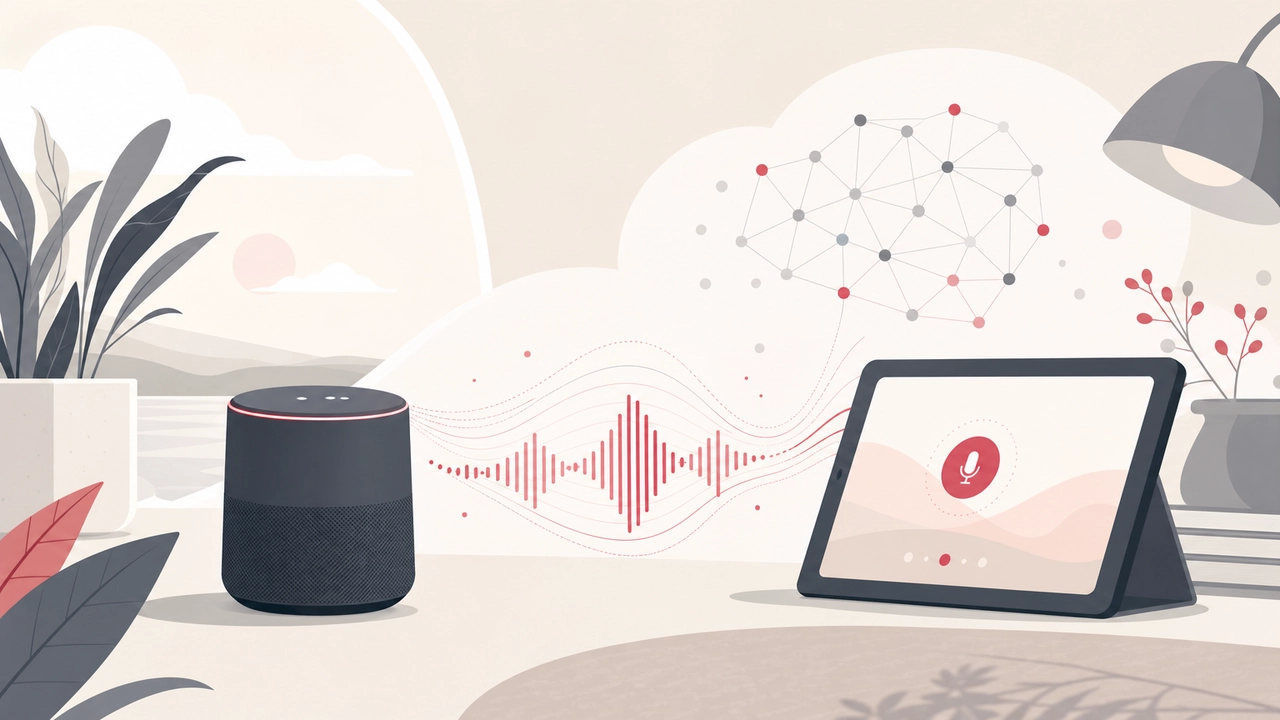
Before smartphones, smart speakers, or voice assistants, there was just... talking.
It's something I keep coming back to whenever I think about voice AI. Long before we built interfaces around it, conversation was already the interface. It's how we think out loud, work through ideas, and connect with other people.
Every generation of voice technology feels, in one way or another, like it's trying to recreate something humans have always done naturally.
What I Remember About Early Voice Assistants
The first wave of voice products (as far as I remember), the smart home devices, the phone assistants, the customer service bots, had a fundamental problem. They were programmed, not conversational. You could ask for the weather, play a playlist, or get a recipe, but only if you phrased it the right way. Speak naturally, add some hesitation, or layer in a bit of context, and the experience may fall apart.
What was missing was not just better speech recognition. It was the absence of anything resembling comprehension. There was no emotional read, no ability to handle ambiguity, no sense that the agent actually understood what you were after. So the way people ended up talking to these products was robotic by necessity. You had to flatten yourself to fit the interface.
That experience left a mark. For a lot of people, especially those who were not deep in tech, those early interactions built up a real resistance. And when companies started pushing voice agents into customer service lines without doing the slow work to make them actually good, it made things worse. People were forced into voice interactions they did not choose, had a frustrating experience, and walked away more skeptical than before.
It feels like some of that skepticism has carried over, even as the technology itself has improved.
A Shift I Only Noticed Later
Something changed when LLM-based tools started becoming part of everyday workflows. I noticed it in myself before I could fully articulate it. After using ChatGPT or Claude regularly for research and thinking, I opened Siri one day to ask a question and it handed me a list of links to dig through myself. It felt broken. Not because Siri had gotten worse, but because my baseline had moved.
That shift in expectation is real, and I do not think it is limited to people who work in tech. It is happening to anyone who has spent enough time with a tool that actually tries to understand what they are asking, rather than just pattern-matching to a command.
The gap between those two experiences is now visible in a way it was not before.
Things I've Been Noticing About Good Voice Experiences
As I've been thinking more about voice lately, there are a few patterns I keep coming back to.
One thing I keep noticing is how interactive it needs to feel. Human conversation is not one-directional. We adjust based on what the other person says. We pick up on cues. A voice interface that can only respond to the literal surface of what you said, without adapting to the flow of the exchange, will always feel mechanical. That is the core failure of most of the customer service bots people encounter today.
Another thing I've noticed is how messy human thinking actually is. Most people do not speak in clean, structured sentences. We pause. We restart. We circle back. We discover what we actually mean while we are in the middle of saying it. If a voice interface can only handle tidy inputs, it is not really built for how humans communicate. It is built for an idealized version of communication that most of us do not operate in.
I've also started paying more attention to tone. The tone, the pacing, the emphasis, the hesitation, all of it communicates meaning. A response that only processes the words and ignores everything else is missing a significant part of what was actually said. Emotionally intelligent voice AI would pick up on those layers, not just the transcript.
Memory feels surprisingly important. I have written about this before, so I will keep it brief here: starting every conversation from zero is the least efficient form of communication there is. A voice interface that remembers who you are, what you have talked about, and where you left off feels like a real exchange. One that does not feels like talking to a stranger every single time.
I've come to appreciate how effortless voice should feel. This one often gets overlooked: The whole point is that you do not need to find a screen, locate a button, or type anything. You just speak. The interaction should meet you wherever you are, whether you are on the move, in the middle of something, or just thinking out loud. If using a voice interface requires you to stop and orient yourself to a device, something has already gone wrong.
One Last Thought
One thing I've been wondering about is whether improving voice AI is really just the model companies' job. I don't think it is. It feels more like a responsibility shared across everyone building voice experiences.
Most people don't separate the underlying model from the experience they're having. I think customer service is where this becomes most obvious. If a customer service voice agent is frustrating, they're probably not thinking about whose model powers it. They just come away feeling that "this voice system isn't very good"
That makes me think the quality of every implementation matters, not just the tech stack underneath.
Voice is not a new invention. It is the oldest form of communication we have. What feels different now is that technology is starting to adapt to how people naturally communicate, instead of asking people to adapt to the technology.
I'm curious to see where it is going next.
AI Lets You Ship Fast. But Are You Building What Anyone Actually Needs?
I'll be honest: there was a moment where I was genuinely excited by how fast we could ship. Features that would have taken weeks were going out in days. It felt like a superpower. And for a while, I let that feeling do a lot of the thinking for me.
Then I looked at the data.
Some of the features we had shipped so quickly, with so much enthusiasm, were barely being touched by users. Nobody had asked for them. Nobody was using them. They just existed, sitting quietly in the product, a small monument to the speed we had celebrated.
That moment made me stop and ask a harder question: were we actually building the right things, or were we just very good at building things fast?
## Speed Is Not the Same as Progress
There is a cultural shift happening in product teams right now, and I think it is worth naming directly. Speed has become a proxy for competence. If your team ships fast, it looks like your team is performing well. AI has made it possible for almost any team to move at a pace that would have seemed unrealistic just a few years ago, and a lot of leaders are celebrating that.
I am not here to tell people to stop celebrating wins. Shipping faster is genuinely useful. The cost of getting something in front of real users has dropped significantly, and that is a real advantage if you use it well.
But here is the problem. When speed becomes the thing you optimize for, the question of what you are building starts to get quieter. You stop asking whether this feature is solving a real problem. You start asking whether you can get it done by Friday.
The expectation shifts too. When AI helps your team ship three times more than before, stakeholders start expecting three times more output as a baseline. And so the cycle feeds itself: more features, faster timelines, and less time to ask whether any of it is actually working.
That is not productivity. That is just motion.
## The Vanity Trap
One of the things I have noticed is how easy it is to measure the wrong things when you are moving fast.
Teams post about how many features they shipped over the weekend, or how much AI increased their productivity by some percentage. And I get it. Those numbers feel good. They are concrete. They are easy to share. But they are vanity metrics if they are not connected to what users are actually doing with the product.
The slower, harder question is: are the features you shipped being used? Are they solving something real? Are users coming back because of them, or despite them?
When you do the slow work of actually looking at that, the picture is often more complicated than the shipping velocity would suggest. I learned that firsthand. We had moved fast, and we had something that looked like a lot of output. But output and value are not the same thing.
The shift toward rapid, AI-assisted development requires a new philosophy, one that asks teams to be just as rigorous about what they measure as they are enthusiastic about how fast they can build.
## The False Sense of Security
There is something else that happens when AI makes execution feel easy, and it is a little harder to articulate, but I think it is important.
When building something takes months, you have no choice but to do the upfront work. You run user interviews. You do research. You prototype and iterate before a single line of code gets written. You go through the cycle carefully because the cost of getting it wrong at the end is too high.
When building something takes days, that discipline starts to feel optional. Why spend two weeks on research when you could just ship a version, see what the data says, and remove it if it does not work? The argument sounds rational on its surface. And in some cases, it actually is rational.
But the risk is that you start treating real users as your testing ground by default, without ever doing the slower work of understanding what they actually need before you build. You end up with a product that is full of fast experiments and short on intentional design. And users can feel that. It shows up in the experience.
The data you collect from a feature nobody asked for is not the same as insights gathered from real conversations with users. One tells you what people did with what you gave them. The other tells you what they actually wanted. Both matter, but only one of them requires you to slow down.
## What a More Honest Approach Looks Like
I want to be clear: I am not arguing against using AI in the development process. I am arguing against letting the pace AI enables become the measure of whether your team is doing good work.
The teams I think will get this right are the ones asking a different set of questions. Not just, how fast can we ship? But also, what are we shipping toward? Not just, how much did we build this quarter? But also, which of it is actually being used, and what is it telling us about what users need next?
That means being willing to do the slow work even when AI makes the fast path available. It means treating user research as a discipline, not a checkbox. It means looking at your data with genuine curiosity instead of confirmation bias, and being honest when something you shipped is not landing.
It also means being thoughtful about which metrics you celebrate. Shipping velocity is worth noting. Adoption, retention, and real user behavior are worth measuring carefully.
Nobody has a definitive answer for how to navigate this shift yet. The field is still figuring it out, and I think the most honest thing any PM can say right now is that we are all watching, questioning, and adjusting as we go. The teams doing it well are the ones who have not let the excitement of moving fast replace the discipline of thinking clearly.
AI gave us a faster track to the market. What it did not give us is a shortcut to understanding people. That part still requires patience, attention, and the willingness to sit with what the data is actually saying, even when it is less flattering than the shipping count.
Speed is a tool. Judgment is the job.
AI Made Execution Cheap. Judgment Is Expensive Again.
Anyone can generate a UI now. Anyone can prompt their way to a persona, a copy variant, a set of user stories, or a first-draft wireframe in the time it used to take to book a design review. The tools are fast, the output looks credible, and the barrier to shipping something has never been lower.
That last part is the problem.
Because lowering the barrier to shipping also lowers the barrier to shipping something sloppy. AI doesn't introduce mediocrity into product teams. It just makes it easier to scale mediocrity faster, with more polish, and with less awareness that it happened.
The teams doing it well aren't moving faster because of AI. They're thinking more clearly because of it. And that distinction matters more than most product conversations acknowledge.
## AI as Collaborator, Not Decision Maker
The most useful mental model for working with AI in product and design isn't "AI as tool." It's AI as collaborator, with a very specific scope of authority.
Here's what that looks like in practice. When working through a new feature or product problem, the process isn't to hand the problem to AI and ship what comes back. It starts with the problem itself: Why does this problem exist? Is there a real need here for the users this product serves? From there, AI becomes genuinely useful for exploring the landscape, generating options, summarizing research, drafting alternatives, and surfacing possibilities that human thinking alone might not reach as quickly.
But then comes the step that determines whether any of it is worth anything: human evaluation. Not a quick gut check, but a real assessment grounded in past experience, business context, user understanding, and product judgment. That evaluation layer is what separates a collaborator relationship with AI from a dependency on it.
AI is good at brainstorming, good at first drafts, good at generating alternatives, rewriting copy, organizing information, and doing analysis faster than any person could. These are real and significant strengths. What AI is not yet capable of is understanding the user in any deep or organizational sense, navigating the politics of a business, or knowing which tradeoff to make when strategy, user need, and technical constraint collide. Those gaps are not minor. They are exactly where product teams earn their value.
## The Real Differentiator Has Always Been Judgment
There was a time when execution separated good designers from great ones. The ability to produce clean, consistent, technically sound work mattered because it was hard to do. That time has passed. AI can now generate UI, illustration, personas, and copy at a quality level that puts execution within reach of almost everyone.
So what differentiates a great PM or designer now? Taste. Craft. Judgment.
Not the ability to generate ten options quickly, but the ability to look at those ten options and know which one is actually right. Right for the users. Right for the business. Right for where the product needs to go and why. That knowledge doesn't come from a prompt. It comes from doing the slow work: the research, the user conversations, the pattern recognition built over time, the hard thinking about what a product is actually trying to do for the people using it.
This is where intentionality becomes a design decision in itself. Using AI with intention means going deep on the thinking before the prompt, not after. When working on a feature, the prompt isn't just "design me this thing." It carries the full weight of the thinking behind it: the user need, the business context, the constraints, the tradeoffs already considered. That depth is what makes AI output useful rather than just plausible.
Speed, by contrast, isn't the goal. It's a byproduct. When speed becomes the goal, what gets compressed is the thinking. And shallow thinking, at AI speed, produces shallow products at a scale that would have been impossible before.
## What Designing with Intention Actually Looks Like
The practical shift for PMs and designers working in AI-first environments is less about process steps and more about where ownership lives.
Ownership of the judgment call cannot be delegated to AI. The product team, the people who understand the business, the users, and the specific context in which a product operates, owns that piece entirely. AI can expand the possibility space. It cannot tell the team which possibility to choose.
Validation with real users still has to happen. AI-generated outputs, no matter how polished, are hypotheses until they've been tested with the people who will actually use the product. The feedback loop from real users is what closes the gap between "plausible" and "right."
And before shipping anything, the honest question to ask is not "did AI save us time here?" but "did AI help us make a better decision?" Time saved that results in a worse product isn't efficiency. It's just faster failure.
Designing for trust, which is increasingly where the stakes in AI-powered product work live, requires that kind of care at every step. Users can feel when a product was shipped without that care. It shows up in the seams, in the moments that feel slightly off, in the interactions that are technically functional but don't quite earn confidence. Sloppy products, even when they're AI-assisted, still feel sloppy.
The teams that will build something worth using are the ones who hold onto that standard. Not because AI doesn't help, but because they understand clearly what it helps with and what it doesn't. Judgment, taste, and the willingness to do the slow work when it matters: those have always been the differentiators. They just matter more now.
AI Gives You the Answer Fast. That's Exactly Why You Need to Slow Down.
There is a particular kind of confidence that comes with a clean AI-generated insight. The numbers are organized, the trends are highlighted, and the narrative practically writes itself. For a product manager working against deadlines and stakeholder pressure, that kind of clarity feels like a gift. It is also, if you are not careful, a trap.
Speed is the selling point of AI in product workflows. But speed only serves good decision-making when the person receiving the output has enough context to know what to trust, what to question, and what to dig into further. Without that foundation, fast answers do not accelerate good thinking. They just get you to the wrong conclusion sooner.
## When the Data Tells a Story That Is Not True
Consider a scenario that plays out more often than most PMs would admit. An AI-assisted analysis surfaces what looks like a significant win: a meaningful spike in form submissions and page visits across a client's website. The numbers are real. The trend appears clear. For a less experienced practitioner, that is the insight. Report it, celebrate it, move on.
But experienced judgment asks a different question first: does this make sense?
In this case, the spike was real, but the cause was not what it appeared to be. A deeper manual investigation revealed unusual bot activity occurring on specific pages over a single weekend day. The outlier was skewing the data entirely. Without that extra layer of scrutiny, the insight would have been wrong, the client would have been misled, and trust would have eroded the moment reality failed to match the expectation that had been set.
This is not a story about AI failing. The tool did what it was designed to do: it surfaced patterns in data quickly. The risk was never in the technology. The risk was in treating its output as a finished answer rather than a starting point.
When a client lacks the technical background to interpret performance data independently, they rely entirely on the PM to translate it accurately. Presenting an AI-generated insight without verification does not just create a reporting error. It sets expectations that the work cannot eventually meet. It shapes how a client understands their own business trajectory. Correcting that narrative later is far more costly than taking the time to verify it upfront.
## The Multiplier Problem
There is a framing that captures this dynamic well: AI is a multiplier. It amplifies what is already there. For a PM who has built genuine fluency in their domain, who has done the slow, unglamorous work of learning how data behaves, how platforms report, where noise tends to hide, AI becomes a powerful accelerant. It compresses hours of manual analysis into minutes and frees up cognitive space for higher-order thinking.
But a multiplier applied to a weak foundation does not produce strength. It produces more of the weakness, faster. A junior PM who has not yet developed the intuition to sense when something feels off is not protected by AI tools. They are more exposed by them, because the speed of the output can feel like confidence it has not actually earned.
This is worth sitting with, especially in teams that are rapidly adopting AI workflows without thinking carefully about who is using them and at what stage of their development. Automation can inadvertently compress the learning curve that builds real judgment. If a PM never has to wrestle with raw data, never has to manually cross-reference sources, never has to sit with ambiguity long enough to develop a read on it, they miss the reps that make expertise durable.
The practical implication is this: the path to using AI well is not to start with AI. It is to first build enough working knowledge in your domain that you know what good looks like, what anomalies feel like, and where to look when something does not add up. That foundation is what transforms AI from a liability into a genuine competitive advantage.
## Doing the Slow Work on Purpose
There is no shortcut to the kind of judgment that catches a bot activity spike before it becomes a client presentation disaster. It comes from doing the slow work: manually pulling data, comparing across platforms, building your own sense of what normal performance looks like in your specific context, and developing the professional instinct to pause when a number seems too clean.
For anyone early in their PM career, the advice is straightforward even if it is not easy. Find your niche and go deep on it. Resist the pressure to let AI carry the analytical load before you have put in the time to understand what that load actually involves. Learn to read data without a summarization layer between you and it. Build your own storytelling process around insights, not because it is more efficient, but because it is how comprehension actually forms.
The goal is not to avoid AI. The goal is to reach a point where working with it feels like having a highly capable collaborator rather than a black box you are hoping to trust. That shift only happens when the practitioner brings enough expertise to the table to evaluate what the AI produces, push back when necessary, and fill in the gaps that no model can reliably cover.
The human part of this work matters more than it is sometimes given credit for in conversations about AI productivity. Data does not interpret itself. Insights do not automatically connect to the right context. Clients do not just need accurate numbers; they need someone who understands their business well enough to tell them what the numbers actually mean and what they do not. That layer of judgment, grounded in experience and sharpened by practice, is not something AI replaces. It is what makes AI useful in the first place.
## The Judgment Layer Cannot Be Automated
The most important capability a PM can develop right now is not prompt engineering or tool fluency, though both have their place. It is the ability to receive a fast AI output and know, with confidence, whether to act on it, question it, or investigate further. That is a human skill. It takes time to build, and there is no version of AI that builds it for you.
The insight that almost became a misleading client report is a useful reminder: AI will keep getting faster. The question is whether the people working with it are developing the depth to keep up. Speed without judgment is not an asset. It is a risk that compounds quietly until it cannot be ignored.
Do the slow work. Build the foundation. Then let AI do what it does best.
AI Has Changed How People Search for Information, and Critical Thinking Is Paying the Price
There is a quiet shift happening in how people find and consume information, and it is easy to miss because it feels so seamless. Working through a client project recently, something stood out in the data: click-through rates to individual web pages were declining, even for content that was genuinely useful and well-positioned. The culprit was not poor content quality. It was Google's AI Overview, which now summarizes search results directly on the results page, answering the user's question before they ever visit a single website.
That observation opened up a much larger question. AI has not just changed where people find information. It has fundamentally changed how people search, how they consume what they find, and how much they think critically about it. And just like social media before it, the convenience comes with a cost that most people are not paying close enough attention to.
The Search Behavior Has Already Changed
Not long ago, searching for something meant typing a few fragmented keywords into a search bar and then digging through a long list of results, one by one. It meant spending hours, sometimes days, reading through materials, extracting relevant points, and synthesizing information into something usable. The process was effortful, but that effort was part of what made it valuable. People built their own understanding by doing the work.
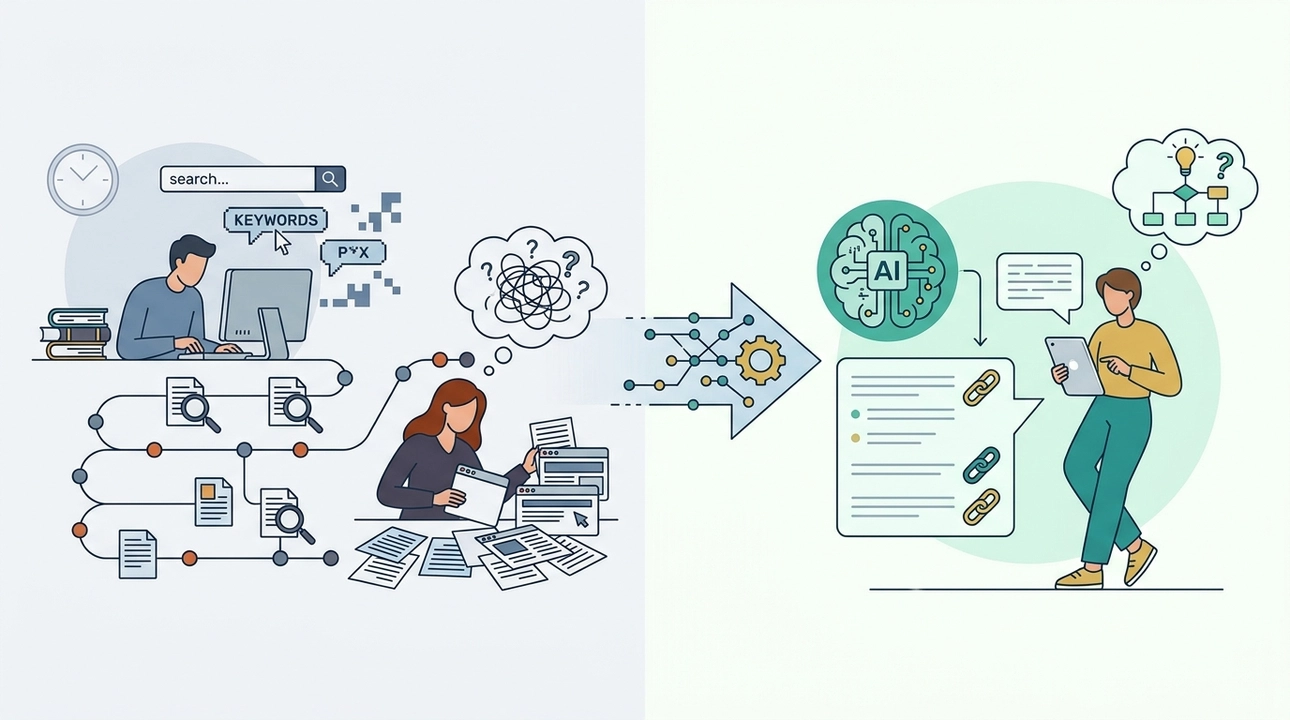
That is largely gone now. The way people input queries has shifted dramatically. Conversational, plain-language questions have replaced keyword strings. With large language models, people go even further, typing out paragraphs of raw, unstructured thought and receiving a coherent, organized response in return. The barrier between a question and an answer has nearly disappeared.
The information consumption flow has changed just as dramatically. AI systems, whether embedded in search engines or accessed directly as language models, now summarize and synthesize for the user. Instead of sifting through a dozen sources, a person receives a distilled answer and a handful of links to explore further if they want to go deeper. The cognitive load of researching has been reduced to a fraction of what it once was.
There’s a quiet shift happening in how people find and consume information, and it’s easy to miss because it feels seamless. In a recent client project, the data showed something striking: click-through rates to individual web pages were falling even when the content was strong. The issue wasn’t quality. It was Google’s AI Overview—answering the question on the results page, before anyone visits a site.
That small metric change points to a bigger reality: AI isn’t just changing where people get information. It’s changing how they search, how they consume what they find, and how much critical thinking they do along the way. And like social media before it, the convenience comes with a cost that’s easy to ignore.
Search Has Already Changed
Search used to be work. You typed keywords, opened tabs, compared sources, and slowly built understanding. The effort was the point—because it forced evaluation, synthesis, and judgment.
Now, queries are conversational. People type full questions—or messy paragraphs of thought—and get clean, coherent answers. AI collapses the distance between question and conclusion. It also collapses the research process itself: instead of exploring a landscape of sources, users receive a summary and a few optional links.
That’s a real efficiency gain. But efficiency isn’t the same thing as understanding.
Frictionless Information Has a Hidden Tradeoff
Used intentionally, AI search is incredibly useful. It reduces noise, speeds up research, and helps people focus. For knowledge work, that’s a meaningful advantage.
But pre-summarized information changes the reader’s role. When the “thinking work” (weighing sources, noticing contradictions, testing assumptions) is done by the system, the user practices it less. Over time, that muscle weakens—not because people don’t care, but because the workflow no longer requires it.
It also creates source blindness. AI outputs often feel authoritative while their origins stay vague. People accept answers without checking where they came from, how current they are, or what they might be missing.
This is where the social media parallel matters. Social media didn’t damage attention and judgment overnight—it did it gradually, by optimizing for ease and volume over depth. AI-mediated search isn’t the same medium, but it carries a similar structural risk: the less effort information requires, the less engaged the consumer has to be—and the more likely they are to accept what’s given instead of interrogating it.
What This Means for AI Product Builders
For teams building AI-native SaaS products, this is more than cultural commentary. It affects product design and trust.
Users increasingly arrive with information that’s already filtered and summarized by AI—along with assumptions that may be incomplete or wrong. Products need to account for that reality: where in the journey should the user slow down and verify? How does your product encourage good judgment rather than simply producing fast answers?
The best AI products don’t just make users quicker. They make them more capable. There’s a difference between:
a tool that gives conclusions, and
a tool that helps users develop discernment.
That difference becomes a long-term moat.
This shift also changes how credibility works. In an AI-mediated world, visibility isn’t only about SEO and volume. It’s increasingly about whether your brand appears coherent and trustworthy across signals—because AI systems “read” authority more holistically than a keyword-ranking algorithm ever did.
The Real Risk Is the Awareness Gap
The biggest issue isn’t that AI exists—it’s that many people don’t notice how it’s reshaping their behavior in real time. Like social media, the effects creep in under the cover of convenience.
The antidote isn’t rejection or paranoia. These tools are too useful and too embedded. The antidote is conscious use: treating AI output like any other source worth interrogating—asking follow-ups, checking primary materials, and being deliberate about when to outsource thinking versus when to do it yourself.
Technology evolves faster than behavior, and behavior evolves faster than awareness. Closing that gap—between what AI can do and what people understand about how it’s shaping them—is one of the most important challenges of this moment.
This is, on its surface, a remarkable efficiency gain. But efficiency is not the same as understanding.
The Double-Edged Nature of Frictionless Information
Used intentionally, AI-powered search is genuinely powerful. It helps people move faster, focus their research more precisely, and surface relevant information without getting lost in irrelevant material. For product teams, knowledge workers, and anyone who needs to make informed decisions quickly, that is a real advantage.
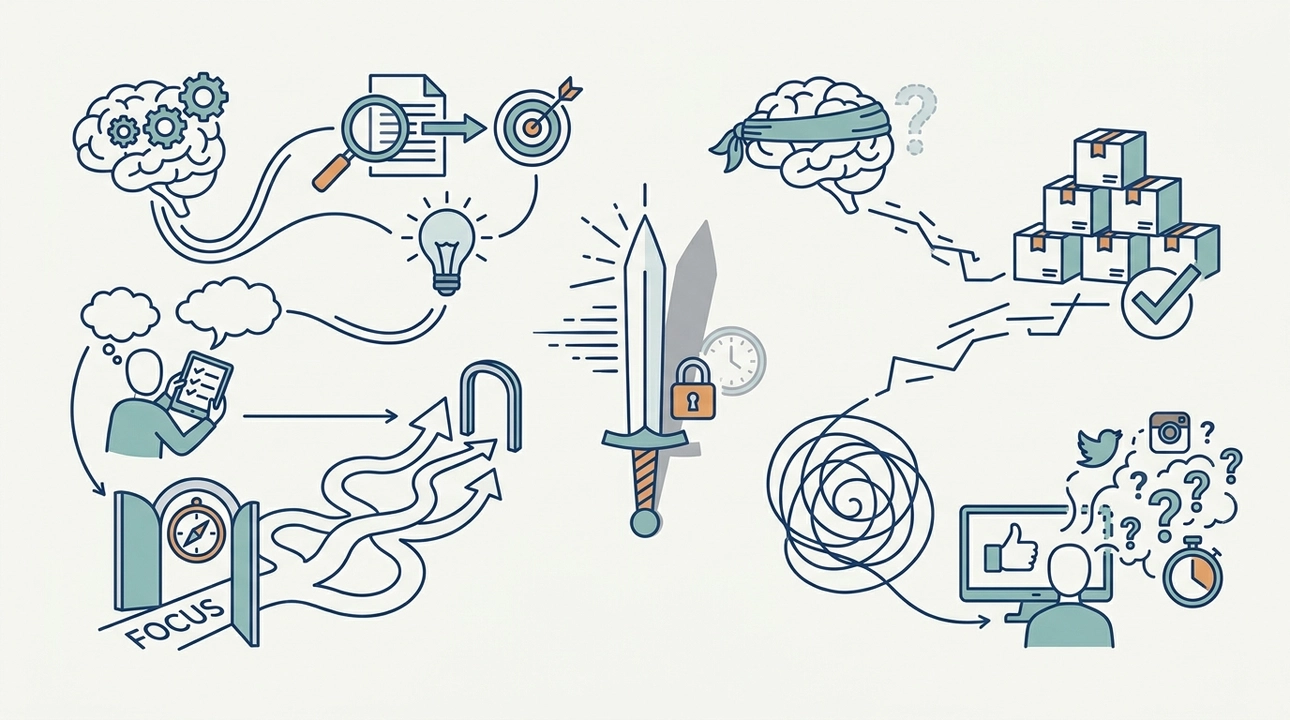
But there is another side to this. When information arrives pre-summarized and pre-interpreted, it reduces the need for the reader to evaluate, challenge, or question what they are receiving. The critical thinking that used to happen during the search process, the weighing of sources, the noticing of contradictions, the forming of independent judgment, gets bypassed. Over time, that capacity can quietly atrophy.
There is also the issue of source blindness. When an AI surfaces an answer, the origin of that answer is often invisible or overlooked. People accept the output without asking where it came from, whether it is current, or whether it reflects a complete picture. This is a meaningful shift from the old model, where the act of clicking into individual sources at least created some exposure to the origin and context of information.
The parallel to social media is worth sitting with seriously. When social platforms first emerged, they represented an extraordinary democratization of expression. Anyone could share a thought with the world instantly, without the gatekeeping of traditional media. That was genuinely transformative. But the same architecture that opened the door to everyone also opened the door to everything, and over time, people found themselves doom-scrolling through a torrent of content, much of it misleading or low-quality, without the tools or habits to filter effectively. The phrase "amusing ourselves to death," borrowed from cultural criticism, captures something real about what happens when the medium optimizes for consumption over comprehension.
AI-mediated search is not social media, but the structural risk is similar. The easier and more frictionless information becomes to access, the less actively engaged the consumer needs to be. And the less actively engaged they are, the more vulnerable they become to accepting what is given rather than questioning it.
What This Means for People Building AI Products
For product managers and teams building AI-native SaaS products, this behavioral shift is not just an interesting cultural observation. It has direct implications for how products get designed, how users are supported, and how trust gets built over time.
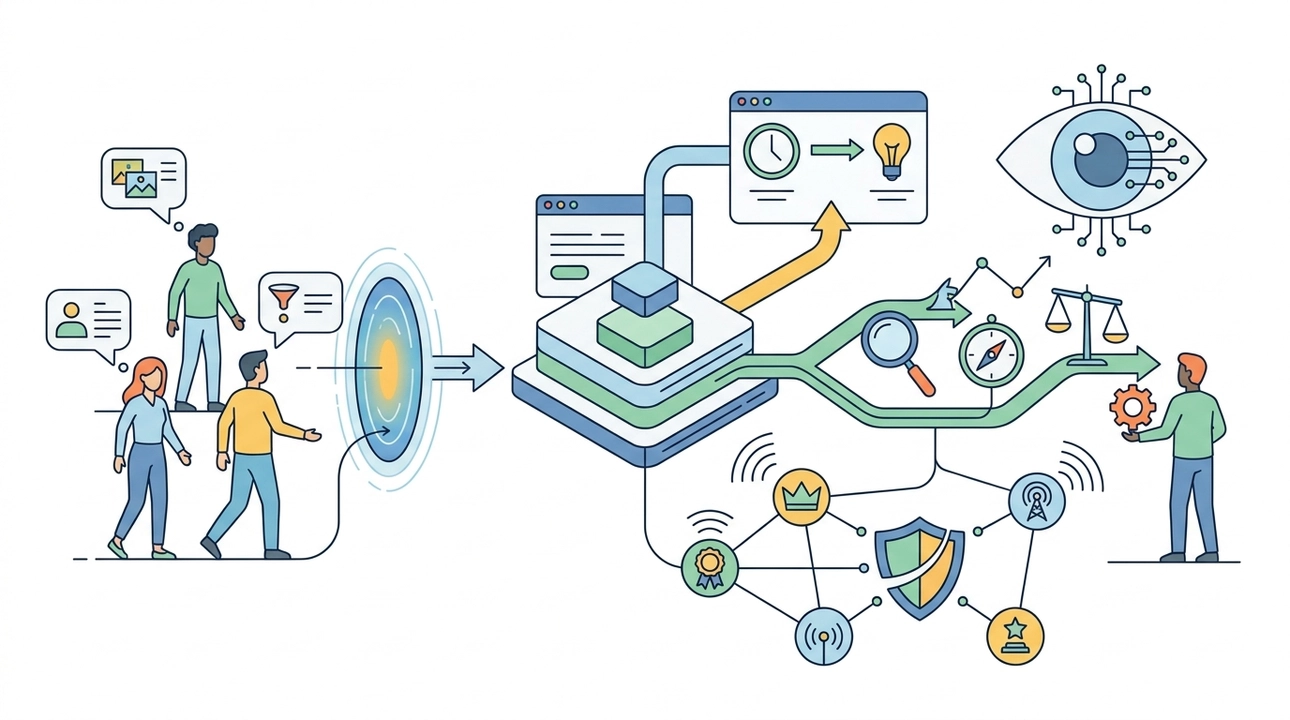
If users are increasingly arriving at products with information that has already been summarized and filtered by AI, they may be bringing assumptions or conclusions that are incomplete. Designing for that reality means thinking carefully about where in the user journey critical evaluation actually needs to happen, and whether the product is helping or hindering that process.
There is also a responsibility question. Building AI-powered features that further smooth away friction in information consumption is not inherently wrong, but it requires intentionality. The best AI products do not just make things faster. They make users more capable. There is a meaningful difference between a product that answers a question and a product that helps a user develop better judgment. The former is useful in the short term. The latter builds lasting value.
Brand and credibility also need to be rethought in this environment. In the old model, visibility was largely a function of keyword optimization and volume of content. In the AI-mediated model, what gets surfaced and trusted is shaped by something more holistic: the coherence, authority, and consistency of a brand's presence across many signals and touchpoints. A brand is increasingly read by AI the way a person is read by their professional network, not just by what they publish, but by how all of it holds together. That requires thinking in systems, not in individual tactics.
The Awareness Gap Is Where the Real Risk Lives
The most important thing to understand about this shift is not the technology itself. It is the awareness gap between how AI is changing behavior and how conscious people are of that change happening to them.

Social media's harms were not obvious while people were in the middle of them. They crept in quietly, under the cover of convenience and connection. AI's influence on how people think, search, and evaluate information carries a similar risk of being invisible until the effects are already significant.
The antidote is not to resist AI or to treat it with suspicion. The tools are too useful and too embedded in how work gets done for that to be a practical position. The antidote is conscious use: approaching AI-generated information with the same skeptical curiosity that a good researcher would bring to any source, asking follow-up questions, seeking out primary material, and staying deliberate about when to outsource thinking and when to do it yourself.
Technology evolves faster than behavior, and behavior evolves faster than awareness. Closing that gap, between what AI can do and what people understand about how it is shaping them, is one of the more important challenges of this moment.
Building User Trust in AI-Powered SaaS: What Product Managers Need to Understand
There is a moment every product manager working in AI eventually faces. The feature is built, the data looks promising, and the rollout plan is solid. But the users? Some of them are not convinced. Some are watching from a distance. Others have already made up their minds that this is not for them. That tension between what a product can do and what users are willing to trust it with is one of the most underexplored challenges in AI product development right now.
Trust in AI-powered products is not a binary switch. It does not simply turn on when the product is good enough. It builds, slowly, through a mix of experience, context, and perception. And for product managers, understanding the shape of that trust journey is just as critical as shipping the feature itself.
## The Spectrum of Skepticism (and Why It Is Actually a Good Sign)
Spend any time in product communities, online forums, or social spaces where creators, operators, and professionals gather, and a pattern becomes clear. When it comes to AI, people do not land in one place. There are the early movers who adopt fast and advocate loudly. There are the experimenters who are genuinely curious but cautious. There are the observers who are watching carefully before committing. And then there are the skeptics who are holding firm, unconvinced.
What is easy to miss is that this spectrum is not a problem. It is a signal. Each of these groups is telling a product team something important about what trust actually requires, and where it is still missing.
The skeptics, in particular, are worth paying close attention to. They are not simply resistant to change. Many of them have legitimate concerns, about quality, about authenticity, about what it means for their craft or their workflow. A copywriter who pushes back on an AI-assisted writing product is not necessarily being closed-minded. They may be asking a question the product has not yet answered: will this make my work better, or will it make me replaceable?
That question matters. And the product managers who treat it as friction to overcome, rather than a signal to understand, tend to build products that win early adoption but struggle with lasting trust.
## What Actually Shifts Someone from Skeptic to Advocate
The more interesting question is not why people are skeptical. It is what changes their mind. And it is rarely a single moment or a clever marketing message. It tends to be something slower and more personal.
Consider the arc of a skeptical user who eventually comes around. What often happens is not that they were convinced in a conversation. It is that they had an experience, however small, that reframed what the product meant to them. Maybe the output was better than they expected. Maybe it saved them time in a way they could not ignore. Maybe a peer shared a result that shifted their reference point. Over time, repeated exposure to something that genuinely works in their context has a compounding effect on perception.
This has real implications for how AI-powered products are built and positioned. Features that generate impressive demos are not the same as features that build trust over time. Trust comes from consistent, contextually relevant value delivered in ways that respect how the user already works. It comes from transparency about what the AI is doing and what it is not doing. It comes from giving users enough agency that they feel like partners in the process, not passengers.
For product managers, this means the launch is not the finish line. The post-launch period, where real users are forming real impressions in real workflows, is where trust is actually built or lost. That is the phase that demands the most attention, and the most humility.
## The Product Manager's Role in Shaping the Trust Environment
There is a tendency in product circles to frame trust as a UX problem or a communications problem. Write better onboarding copy. Add an explainability layer. Run a trust-building campaign. These are not wrong, but they are incomplete. Trust in AI products is also a product strategy problem, and it starts long before the first user ever logs in.
The decisions made during development, about what data the model uses, how outputs are surfaced, what controls users have, and how errors are handled, all shape the trust environment users walk into. A product that is opaque about how it reaches a result, or that overclaims what it can do, is setting up a trust deficit that no amount of onboarding can fix.
This is where the product manager's role becomes particularly significant. Sitting at the intersection of technical capability, user needs, and business goals, a PM has the rare ability to ask the questions that others might not think to ask. What happens when the AI gets it wrong? What does the user experience in that moment, and does it make them more or less likely to try again? Is the product being honest about its limitations, or is it papering over them with confident-sounding language?
These are not just ethical questions, though they are that too. They are strategic ones. Products that earn trust by being transparent and genuinely useful in imperfect moments tend to build the kind of loyalty that is very hard to replicate. Products that overpromise and underdeliver in ways that feel invisible tend to erode trust quietly, until users simply stop engaging.
The AI content landscape is still relatively new. There are users at every stage of the adoption curve, and there are still vast portions of the market that have not yet formed a firm opinion. That is an enormous opportunity, but it is also a responsibility. The habits and norms being established right now around how AI products earn trust will have a long tail.
## Trust Is a Product, Not a Promise
At the heart of all of this is a simple but easy-to-forget idea: trust is not something that gets communicated into existence. It is built through what a product actually does, repeatedly, in the hands of real people with real stakes.
The most durable AI products will not be the ones with the flashiest features or the most aggressive launch strategies. They will be the ones built by teams that took the full spectrum of user skepticism seriously, that designed for the observer as thoughtfully as for the early adopter, and that understood trust as a long-term outcome worth engineering for.
That is the work. And for product managers working at the intersection of AI and human experience, it may be the most important work of all.
The Ethics of Speed: How Product Managers Hold the Line in AI Development
There is a particular kind of pressure that lives in the space between a sprint deadline and a nagging instinct that something is not quite ready. In AI product development, that pressure is not just common. It is constant. The culture of fast shipping has always been a defining feature of tech, but AI has raised the stakes in ways that make speed a genuinely ethical question, not just a strategic one.
Product managers sit at the center of that tension every single day. They are expected to move fast, to ship, to demonstrate progress. And yet they are also the people most responsible for asking whether something should ship at all, and what happens when it does.
## Why Speed Feels Like the Default
There is a reason teams default to moving fast in AI product development. The market moves quickly, competitors are always shipping, and investors and stakeholders want to see momentum. In SaaS specifically, the pressure to iterate at speed is baked into the culture.
But with AI-native products, speed carries a different kind of risk. A poorly designed feature in a traditional SaaS product might frustrate a user or create a support ticket. A poorly designed AI feature can erode trust in ways that are much harder to recover from. It can produce outputs that mislead users, reinforce bias, or make decisions that users did not consent to and cannot easily contest.
The case for moving fast is real. The risks of moving carelessly are also real. The product manager's job is to hold both truths at once and navigate between them with intention.
## What Responsible Shipping Actually Looks Like
Responsible shipping is not about slowing everything down or adding friction for its own sake. It is about building the discipline to ask better questions before something goes out the door.
In practice, that starts with clarity around what the AI feature is actually doing. Not at a technical level, necessarily, but at a user impact level. Who is affected by this output? What happens when the model is wrong? Is there a way for users to understand or contest what the AI has decided? These are not abstract ethics questions. They are product questions, and they belong in the same conversation as timelines and acceptance criteria.
It also means being honest about what is and is not known at the point of shipping. AI products are probabilistic by nature. They do not behave the same way every time. Responsible shipping means having a clear-eyed view of where uncertainty lives in the product and communicating that honestly, both internally and to users.
## The PM as the Person Who Pumps the Brakes
There is an uncomfortable truth in AI product development: often, the product manager is the only person in the room whose job it is to slow down and ask whether something is ready. Engineers are optimizing for code quality. Designers are optimizing for experience. Executives are optimizing for timelines. The PM is the person who has to hold the line on all of those dimensions simultaneously, including the one that asks whether this is responsible to ship right now.
That is a hard position to be in, especially in a fast-moving culture where pumping the brakes can feel like blocking progress. But that instinct to pause is not a weakness. It is one of the most valuable things a product manager can bring to an AI team.
The challenge is developing the judgment to know when that instinct is right and the courage to act on it when it is. That judgment comes from having a clear set of principles that guide decision-making, not just a vague sense that something feels off. It comes from understanding the user deeply enough to anticipate downstream consequences. And it comes from building the kind of credibility with stakeholders that makes it possible to raise a concern and be heard, rather than dismissed.
## Building a Culture Where Responsible Shipping Is the Norm
Individual judgment matters, but it is not enough on its own. The most durable version of responsible AI shipping happens when it is built into how a team operates, not just when a single PM sounds the alarm.
That means making space in the product process for the questions that often get skipped when timelines get tight. It means building lightweight frameworks that make it easier to evaluate readiness across both functional and ethical dimensions. It means treating post-launch review as a genuine learning opportunity, not just a formality.
It also means talking openly about failures when they happen. AI products will occasionally ship something that does not behave as intended. The teams that handle that well are not the ones that avoid it. They are the ones that have built the processes and the psychological safety to surface problems quickly, respond honestly, and iterate with accountability.
In SaaS specifically, where user trust is a core part of the value proposition, that kind of culture is not just the right thing to build. It is a competitive advantage.
## Practical Anchors for Fast-Moving Teams
There are a few questions worth building into any AI product review, regardless of how tight the timeline is.
- What is the worst-case output this feature could produce, and what is the plan if it happens?
- Do users understand what the AI is doing and why?
- Is there a meaningful way for users to provide feedback or contest an AI-generated result?
- What does "good enough to ship" actually mean for this specific feature, and who has agreed on that definition?
None of these questions require a lengthy ethics review or a separate governance process. They can be asked in a standard sprint review or a pre-launch checklist. The goal is not to add bureaucracy. It is to make sure that the conversation happens before the feature goes live, not after something goes wrong.
## The Line Is Worth Holding
Speed and responsibility are not opposites. The best AI product teams find ways to move quickly and ship thoughtfully, because they have built the systems, the culture, and the shared language to do both at once.
But when those two things genuinely conflict, when the timeline is real and the feature is not ready, someone has to hold the line. That is the product manager's job. Not because it is comfortable, and not because it always makes the PM popular. But because no one else in the room is positioned to do it with the same combination of user empathy, business context, and cross-functional accountability.
The ethics of speed in AI product development will only become more urgent as AI capabilities grow and deployment cycles accelerate. The product managers who develop the judgment, the courage, and the frameworks to navigate that tension well will not just be better PMs. They will be the ones shaping what responsible AI actually looks like in practice, one product decision at a time.
How Non Technical Product Managers Can Thrive in the AI Era Without Drowning in Hype or Losing Their Edge
AI didn’t just add a new tool to the product manager toolkit. It changed the pace of product work, the language teams use to make decisions, and the baseline expectations for what it means to be credible in a room.
For product managers without a technical background, the shift can feel especially sharp. Many have built careers on coordination, strategy, stakeholder alignment, and the kind of emotional intelligence that keeps complex work moving. Then, almost overnight, AI became the loudest conversation in tech. Constant releases. Constant predictions. Constant pressure to keep up.
The challenge is not simply learning a new system. It is learning in an environment where the system keeps changing, where hype travels faster than understanding, and where the fear of being behind can quietly erode confidence.
The good news is that the path to thriving is not reserved for the most technical PM in the org. Some of the most compelling voices in the AI space today are product leaders who started from a non technical base, leaned into focused learning, and turned their strengths in communication and perspective into an advantage.
Test changes
The real challenge is not AI. It is the feeling of being forced to learn everything at once
Product managers have always needed to learn the technology of their domain. That part is not new. What is new is how AI arrived: fast, noisy, and socially amplified.
When a space moves that quickly, learning can start to feel like chasing. Instead of building understanding layer by layer, many PMs end up skimming surface level content across dozens of topics. That pattern creates a predictable outcome: a growing sense of intimidation paired with the suspicion that everyone else knows more.
This is where many capable PMs get stuck. Not because they cannot learn, but because the environment encourages a scattered approach.
The skill to build now is not memorizing AI terminology. It is designing a learning strategy that works under high change.
Emotional intelligence is still the differentiator, and AI makes it more valuable
As AI becomes more present in product development, it is tempting to treat technical knowledge as the only currency that matters. That assumption misses what teams actually need in order to ship real products.
AI introduces new ambiguity into product work—deciding what should be automated versus what should remain human-led, how to weigh speed against reliability, how to talk about limitations without killing momentum, how to set expectations when outputs are probabilistic, and how to align stakeholders when the technology is evolving mid-roadmap. These are not purely technical questions. They are product questions, and they are fundamentally human.
Emotional intelligence remains irreplaceable because it governs how decisions get made under uncertainty. It shows up in the ability to facilitate alignment when the room contains both excitement and fear, ask clarifying questions without posturing, translate complex system behavior into implications for customers, and handle disagreement without turning it into dysfunction. In an AI-heavy landscape, the PM who can keep a team calm, curious, and aligned becomes more valuable, not less.
The goal is not to abandon soft skills in favor of technical skills. The goal is to use soft skills to accelerate technical learning and to turn technical learning into better product judgment.
Focus over frenzy: build depth, stay broadly literate, and contribute as you learn
Trying to learn all of AI is a guaranteed way to feel behind. Thriving starts with prioritization. A practical approach is to choose one focused area to start with—something that connects to the product domain you already work in, is likely to matter to customers or internal teams in the next one to two quarters, and can be explored through real examples and repeated exposure. Once you’ve chosen that starting point, the learning process becomes more grounded: learn from subject matter experts who explain fundamentals without relying on hype, read books and authentic writing that prioritizes clarity over clicks, and spend enough time in the topic that concepts begin to connect rather than simply accumulate. Depth builds confidence, and confidence makes learning sustainable. This also creates a healthier relationship with the rest of the AI noise: not everything outside your focus area needs to be ignored, but it should be treated differently. The expectation is not mastery of every subfield—it’s practical literacy.
One of the simplest ways to reduce overwhelm is to use a two-tier learning model. Tier one is your focus area, where you build real depth and aim to become the person who can speak with clarity, ask sharper questions, and make better product tradeoffs in that slice of AI. Tier two is everything else, where the goal is conceptual understanding: what a tool or approach is designed to do, its pros and cons, its limitations, and the kinds of problems it tends to solve well or poorly. This prevents a common failure mode—spending so much time trying to understand everything that nothing becomes usable—and it maps cleanly to real product work. Product managers rarely need to implement systems, but they do need to evaluate them, communicate about them, and decide how they fit into a roadmap.
Thriving also means contributing to the conversation rather than waiting for permission. Many PMs who have become visible leaders in the AI space—even without technical backgrounds—share what they are learning and what they are seeing during the process, not after achieving perfect mastery. A key differentiator is the willingness to express opinions publicly even when uncertainty is present; over time, that consistency compounds into clearer thinking, a growing community, and new opportunities. This isn’t about chasing attention. It’s about building professional leverage in a world where AI conversations shape product decisions. The most sustainable way to do it is to share from direct experience: a takeaway from a credible book or article and how it changed your product thinking, a reflection on what feels overhyped versus genuinely useful, a framework for evaluating AI features beyond the demo, or a lesson learned about cross-functional alignment when AI enters the roadmap. Even imperfect perspective can be valuable because it invites collaboration and gives others language for what they’re also struggling to articulate. This is often where imposter syndrome shows up—and the irony is that the people most affected tend to be thoughtful enough to be useful. In a fast-moving space, the brave act isn’t claiming certainty; it’s contributing honestly and consistently.
To make all of this workable, non-technical doesn’t mean non-credible—it means your operating system needs to be intentional. Define a learning priority and a realistic time box, because small repeated sessions beat occasional marathons and keep you in the conversation long enough for understanding to deepen. Build a personal library of trusted inputs—authentic sources and experts who teach fundamentals, not just trends—so you reduce whiplash and spot hype faster. Then translate each learning cycle into product language by forcing clear answers to what this enables, what it breaks, what it changes about the customer experience, and what new risks appear. This translation step is where non-technical PMs often excel, because it’s already core to the job. Finally, share consistently to clarify your thinking and build community; consistency matters more than scale, and even short reflections create a feedback loop that attracts practitioners who expand your learning network.
The mindset shift underneath all of it is simple: AI is a space to navigate, not a test to pass. There is no finish line where you’re suddenly “caught up.” AI is an evolving landscape, and thriving comes from building the capability to keep learning without burning out while preserving the human strengths that make product management effective. The PM who wins isn’t the one who tries to know everything—it’s the one who prioritizes what matters, learns deeply enough to make good decisions, stays conceptually literate across the broader space, uses emotional intelligence to lead through uncertainty, and contributes perspective so others can move faster too. The AI era rewards speed, but it punishes noise, and that tension creates a quieter kind of advantage: clarity—clarity about what to learn first, what matters to customers, what the limitations are, and how to communicate when teams feel overwhelmed. When the landscape keeps moving, the sustainable response isn’t to sprint forever; it’s to build a compass: focused depth, broad literacy, and the confidence to share grounded perspective while keeping the work human.
When the landscape keeps moving, build a compass
AI will keep changing. New tools will keep arriving. The conversation will keep accelerating.
The sustainable response is not to sprint forever. It is to build a compass: a focused learning strategy, a commitment to conceptual literacy, and the confidence to share perspective in public.
In a world full of hype, the product leaders who stand out are the ones who stay grounded, keep learning, and keep the work human.
AI did not just add a new tool to the product manager toolkit. It changed the pace of product work, the language teams use to make decisions, and the baseline expectations for what it means to be credible in a room.
For product managers without a technical background, the shift can feel especially sharp. Many have built careers on coordination, strategy, stakeholder alignment, and the kind of emotional intelligence that keeps complex work moving. Then, almost overnight, AI became the loudest conversation in tech. Constant releases. Constant predictions. Constant pressure to keep up.
The challenge is not simply learning a new system. It is learning in an environment where the system keeps changing, where hype travels faster than understanding, and where the fear of being behind can quietly erode confidence.
The good news is that the path to thriving is not reserved for the most technical PM in the org. Some of the most compelling voices in the AI space today are product leaders who started from a non technical base, leaned into focused learning, and turned their strengths in communication and perspective into an advantage.
Test changes
The real challenge is not AI. It is the feeling of being forced to learn everything at once
Product managers have always needed to learn the technology of their domain. That part is not new. What is new is how AI arrived: fast, noisy, and socially amplified.
When a space moves that quickly, learning can start to feel like chasing. Instead of building understanding layer by layer, many PMs end up skimming surface level content across dozens of topics. That pattern creates a predictable outcome: a growing sense of intimidation paired with the suspicion that everyone else knows more.
This is where many capable PMs get stuck. Not because they cannot learn, but because the environment encourages a scattered approach.
The skill to build now is not memorizing AI terminology. It is designing a learning strategy that works under high change.
Adapting to AI Change Without Burning Out A Product Managers Playbook for Focused Growth

AI is not just moving fast it is moving differently, with new capabilities, new expectations, and new risks showing up almost weekly. As a product manager building SaaS and AI native experiences, I have learned that the real challenge is not finding more information. The challenge is choosing what to ignore so I can learn what matters, make decisions with confidence, and keep my product and my career moving forward. If you are feeling the pressure to keep up with everything, I want to offer a more sustainable path that still keeps you ahead. Making a change here to complement the blog content.
The new reality AI changes the product managers job every day
In SaaS, we used to plan around predictable cycles. We could map a roadmap, estimate effort, and assume the market would shift gradually. AI has compressed that timeline. Customers now expect smarter defaults, faster personalization, and experiences that feel intuitive without extra setup. At the same time, teams are experimenting with new models, new tooling, and new architectures that can change what is possible between one sprint and the next.
This is where many product managers get stuck. We hear about breakthroughs, we see competitors adding AI features, and we feel responsible for having an opinion on all of it. But the truth is that no one can track every model release, every framework, and every trend across the AI landscape and still do the core job of product management. When I accepted that, my mindset shifted from chasing updates to building a deliberate system for adaptation.
From a client perspective, this matters because product leaders who chase trends often ship unclear value. They add AI because it is expected, not because it is proven. The outcome can be confusing user experiences, rising operational costs, and trust issues when features behave unpredictably. The product managers who win in this environment are the ones who can connect AI decisions directly to customer outcomes and business goals.
Focus beats frenzy How I decide what to learn and what to ship
My guiding principle is simple I do not try to master AI in general. I focus on the parts of AI that intersect with my product, my users, and the decisions I need to make this quarter. This is not about limiting ambition, but about creating leverage.
First, I anchor on core concepts rather than endless news. I want to understand what a capability can and cannot do, what it tends to do wrong, and what it costs to run in the real world. For example, I do not need to become an engineer to ask the right questions about accuracy, latency, evaluation, data privacy, and failure modes. Knowing those fundamentals helps me translate AI from hype into product tradeoffs.
Second, I filter learning through direct impact. I look at my product surface area and ask where AI could meaningfully reduce user effort, improve decision quality, or accelerate time to value. In SaaS, that often means focusing on workflows and outcomes, not features. A good test is to ask whether the AI experience can be expressed as a clear promise to the user. If I cannot explain the promise in one sentence, I am not ready to build it.
Third, I prioritize with a simple portfolio mindset. I usually recommend a mix of three types of work. One is foundational work that improves readiness, like instrumentation, data quality, or feedback loops. Another is low risk experiments that can validate demand quickly. The third is a single high conviction bet tied to a measurable business outcome. This helps teams avoid spreading effort across too many AI initiatives at once. Prioritization is key.
For clients and stakeholders, this approach creates clarity on what to expect. Instead of hearing we are exploring AI, you get a narrative that explains why a use case matters, how it will be evaluated, what success looks like, and what risks are being managed. It turns AI from a vague direction into a disciplined product strategy.
Building products people trust in an AI first market
AI features are judged differently than traditional features. Users do not just evaluate whether a button works. They evaluate whether the product feels reliable, whether it respects their data, and whether the system behaves consistently when stakes are high. Trust becomes a product requirement.
One trend I see accelerating is that AI UX is becoming the differentiator. Many teams can integrate a model. Fewer teams can design the right human AI collaboration, with clear boundaries and thoughtful defaults. That means product managers need to think beyond model selection and consider the whole experience. When should the AI suggest versus act. How does a user correct it. How does the product explain what happened. How does the system learn without feeling intrusive.
Another trend is that evaluation is becoming a competitive advantage. In classic SaaS, we could rely on user feedback and analytics. In AI, we also need structured evaluation, because outputs can look correct even when they are subtly wrong. The teams that build lightweight evaluation into their development process move faster with less risk. This can be as simple as defining failure categories, creating a small set of representative test cases, and reviewing outputs regularly with domain experts.
Finally, I see growing expectations around responsible AI. Even when regulations vary by region and industry, customers increasingly want transparency and control. Privacy, security, and compliance are no longer only legal checkboxes. They are part of brand trust. Product managers who can speak credibly about these topics and design for them early will help their organizations avoid costly rework later.
Closing thoughts
Adapting to change is not about running faster. It is about choosing direction. AI will keep evolving, and none of us can absorb everything. What we can do is stay focused on fundamentals, prioritize learning based on real product impact, and build experiences that earn user trust.
If you are exploring AI for a SaaS product or trying to turn a fast moving set of possibilities into a clear roadmap, I would be happy to talk. Reach out and tell me what you are building, what is changing in your market, and where you feel stuck. I can help you shape a focused strategy that delivers measurable value without the chaos.
Balancing Creativity and Structure: Insights from My Journey as a Product Manager and Content Creator
In my professional journey, balancing the roles of product manager and content creator has taught me invaluable lessons. Both roles demand a high degree of communication and collaboration. As a product manager, managing stakeholders and coordinating across diverse teams sharpens my organizational skills. This oversight capacity is crucial, though, where creativity is often a collective process shared with designers, developers, and writers. Contrastingly, content creation demands acute autonomy and innovation. This role leverages my creativity to develop unique content strategies, requiring me to draw deeply from personal vision and insight. I have found that integrating my product management skills with creative processes has allowed me to navigate and refine the ever-evolving visions of my clients, ensuring that the content resonates and accurately represents their brand voice.
Stronger at the Core: Mental Health Lessons I Wish Every Product Manager Knew
Shipping never sleeps. As a product manager in tech, I have carried the weight of decision fatigue, shifting roadmaps, and dependency knots that do not care about work hours. For a long time, I tried to think my way out of stress. It did not work. What finally changed everything was accepting help, slowing down, and building an inner core that no deadline could shake.
## Why PM mental health frays in modern tech
Tech moves faster than human nervous systems. Always-on channels blur off-hours. Dependencies multiply across squads, vendors, and legacy stacks, while accountability stays ambiguous. One incident can rewire a quarter, and macro volatility adds layoffs or budget freezes to the mix. AI has shortened cycles and raised expectations, but it has not reduced uncertainty.
In this environment, PMs become shock absorbers. We translate ambiguity into bets, shield teams from churn, and manage stakeholders who each think their priority should be first. Without intentional guardrails, the role quietly drains our reserves.
## From breakdown to backbone: how I rebuilt
I reached a breaking point and stepped back from my career to heal. Advice like do not take it personally never landed for me, because the work is personal. So I did something different. I committed to therapy, every week, no matter how awkward or slow it felt. I gave myself mercy when progress looked like baby steps, and grace when there was regression.
Over time, small changes appeared before I noticed them. I could set boundaries without shame. I could voice what I needed. I could ask for help early. My presence softened, my judgment sharpened. That inner core became real: I know who I am, and I do not crumble in the face of a hot take or a surprise escalation. The impact at work is tangible. Stakeholders get clarity without drama. Teams get calm direction. Outcomes improve because decisions are no longer fear driven.
## My early warning system
Today I watch for signals before stress becomes a spiral.
- Sleep shifts or weekend dread creep in.
- I reread Slack messages to find hidden meaning.
- Design and PRD reviews feel combative instead of curious.
- I keep tinkering with timelines even when the plan is good enough.
When two or more signals persist for a week, I act. I pause noncritical scope and surface risk explicitly. I book time with my counselor. I tell my manager what I need, whether that is air cover, a decision, or a trade off. I journal for 15 minutes to separate facts, feelings, and fears. The goal is not to be tougher. It is to intervene sooner.
## Team practices that protect outcomes and people
I now design calm into the product system.
- Clear escalation map: who decides, on what data, by when.
- Decision logs: reduce re-litigation and memory wars.
- Focus blocks and office hours: fewer meetings, better thinking.
- Sprint capacity at 80 percent: planned slack absorbs change.
- Post-incident decompression: normalize recovery, not just root cause.
- Async-first habits: crisp briefs, short updates, fewer pings.
We also track leading indicators of thrash. Deployment frequency volatility, bug reopen rate, and context switching between epic families forecast stress on teams and on the PM function. When those spike, we negotiate scope, not people.
These practices are not soft. They are operational risk management. Clients and partners feel the difference. Decisions come faster. Communication is cleaner. The team sustains pace without burning the core.
The most important lesson is simple. Trust your gut early. If something feels off, it probably is. Reach for help before the smoke becomes fire. Build systems that protect your attention and your humanity. Start with one boundary and one ritual this week. Your future self and your team will thank you.
The Human Side of Product: A Journey to Reset

The Beginning: Finding My Place
When I moved to Canada in 2016 to pursue my graduate program, I carried with me not just my but also a profound sense of uncertainty. Freshly graduated as a university student, I found myself surrounded by talented peers who seemed to have it all figured out already. Every day was an exercise in managing insecurities while trying to learn and grow.
The Path to Product Management
Here’s a more concise version of the text:
My journey wasn't linear. After graduating in 2019, I worked as a project coordinator at a digital agency for two years. When COVID-19 struck, I became unemployed, prompting me to reinvent myself as a freelance UX/UI designer, QA specialist, and content creator. This uncertainty led me to discover my ability to impact others' lives through meaningful solutions.
I later entered product management at a live event company, where I led a cross-functional team to launch and optimize digital solutions that benefited event guests and various internal teams. This experience paved the way for my role as a product owner and eventually a product manager at a Canadian national corporation, where my impact continued to grow.
Let me know if you need any further modifications!
The Decision to Step Back
Sure - this industry is ever growing, and there is always something new to offer. "Fast-paced," "high-growth," and "time-sensitive" aren't just buzzwords – they're the daily reality in the tech industry. Every company and every individual strives for optimization, increased velocity and keeping up with the evolution. Gradually, I became someone who equated slowing down with falling behind, a mindset that would eventually exact a heavy toll.
Through my therapy, I discovered myself living with anxiety since long before I knew it existed in me. My lack of self-care finally made my body gave out before my mind was ready to acknowledge the problem. What started as manageable stress escalated into severe symptoms. Some of them were:
De-realization – the world around me felt unreal. I felt like I was an NPC in the world.
Cognitive dysfunction – I suffered from memory loss and difficulty processing information. It can be extremely dangerous - there was one time I should have stopped for the red light - no brainer - until a car passed in front of me. My eyes saw the ‘red‘, but my brain didn’t process the “red“ as ‘stop‘.
Physical manifestations – shortness of breath, muscle pain, and palpitations.
Emotional numbness - I felt like a robot and lost my sense of happiness, sadness, fear, anxiety or anger.
When my doctor advised immediate leave, it became a turning point. Through therapies, I realized that I needed more than just time off – I needed to heal from the root cause. The decision to resign wasn't easy, complicated by worries about others' perceptions, financial stability, and career implications. But ultimately, I chose my health – because without it, nothing else is possible.
The Recovery Journey
This period of recovery became a time of profound self-discovery. Rather than rushing back into workplaces, I chose to focus on personal growth and learning. I:
Rediscover my love for reading, exploring topics from personal investment to psychology.
Learn to step outside my comfort zone, including becoming more proactive about self-advocacy.
Discover inner peace through art therapy, using creativity as a gateway to my subconscious mind and finding it a profoundly thought-provoking experience.
Embrace physical activity despite not being naturally athletic – finding my rhythm in weight training and Pilates, and even attempting running (though my patience for that tends to run out as quickly as I do!)
Absorb in new knowledge. Currently, I am taking Google's Data Analytics program and Duke University's AI Product Management course.
Finding the Right Support is the Foundation of Recovery
One of the most crucial aspects of my recovery was finding the right therapeutic support. Through trial and error, I learned that finding the right therapist is a deeply personal journey. Here’s what I think is important:
Comfort Level: The ability to openly express thoughts and feelings in a secure environment is fundamental
Empathy and Understanding: Look for genuine empathy and deep understanding of your situation
Cultural Fit: A therapist's cultural background can significantly impact their ability to understand your experiences and decision-making process. In my case, finding a therapist who shared my ethnic background made a profound difference
Therapeutic Approach: Different approaches work for different people – from goal-oriented CBT to talking therapy or art therapy. Take time to discover what resonates with you
Building Your Support System
Recovery isn't a solo journey. A robust support system can make a significant difference:
Personal Connections: Partners, family members, friends, and even neighbors can provide crucial emotional support. Don't underestimate the power of simply sharing your experience with those you trust.
Professional Resources: Mental health professionals are trained to help you navigate challenging time. Don't hesitate to try different therapists until you find the right fit.
Workplace Resources: Many workplaces offer Employee Assistance Programs and other benefits. Take advantage of any financial support available through your workplace benefits. These resources exist to help you; using them is not a sign of weakness but of wisdom.
Looking Forward
This experience has transformed me into a braver, more adventurous person. While I haven't yet returned to workplaces formally, I'm embracing this transition period to explore new possibilities - approaching my next chapter with optimism and curiosity.
The journey has taught me that taking care of oneself isn't just about recovering from burnout – it's about building a foundation for sustainable success in whatever path we choose to pursue.
Disclaimer: This is my personal journey and should not be taken as medical advice. Always follow your healthcare provider's professional guidance.
Work
Bono AI
Bono AI calls you, captures your ideas through voice interviews, and turns them into ready-to-publish content for your website, LinkedIn, newsletter, and more.
11X Ventures
As a venture studio, we build and invest in digital platforms and technologies that redefine possibilities and empower founders and businesses alike.
Onliweb
Build your personal brand, publish content, monetize your time and grow your audience effortlessly. No-code platform for professionals, creators and innovators.
TELUS Home Solutions Ecomm
Shop deals on mobility plans and internet with the network that gives you peace of mind with 5-Year Plan Price Lock.
Enchant Labs
We build experiences & technology that creates magical memories for millions of people.